Land clearing methods for development are specialized site preparation techniques used to remove vegetation, trees, debris, and obstacles from a parcel before construction begins. The method you choose directly affects project cost, timeline, soil stability, and environmental compliance. This guide covers the five core techniques, forestry mulching, bulldozing, mechanical excavation, chemical clearing, and controlled burning, along with the planning steps and best practices every developer and property owner needs before equipment enters the site.
1. Land clearing methods for development: what the process actually involves
Land clearing for development is a multistage process that includes site assessment, surface vegetation clearing, grubbing, debris disposal, and preliminary grading before any foundation work begins. Each stage feeds directly into the next, and skipping steps creates structural and drainage problems that are expensive to fix later. Treating clearing as a single task rather than a sequenced workflow is the most common planning mistake developers make.
The five primary methods used in the industry are forestry mulching, bulldozing or pushover, mechanical excavation, chemical clearing, and controlled burning. Each method suits different site conditions, vegetation densities, and regulatory environments. Selecting the wrong method for your site type adds cost and delays without improving the outcome.
2. Forestry mulching: efficient and low-disturbance clearing
Forestry mulching uses a machine fitted with a rotary drum mulcher to shred standing vegetation into a layer of wood chips and organic material in a single pass. Mulching machines process stems up to approximately 350 mm in diameter, converting biomass directly into erosion-control groundcover on-site. That eliminates haul-away costs and leaves the soil surface protected rather than exposed.
This method preserves the existing soil structure better than bulldozing because the machine does not push or strip the topsoil layer. For moderate-density vegetation sites, forestry mulching is typically faster and more cost-effective than mechanical excavation. Salvationlandmanagement uses forestry mulching as a primary clearing technique across residential and commercial sites in the Charleston Lowcountry, where sandy soils are particularly vulnerable to erosion after clearing.
The key limitation is stem diameter. Forestry mulching is effective for trees under roughly 35 cm DBH (diameter at breast height). Sites with a significant proportion of larger timber require excavation-based methods to maintain schedule and cost efficiency.
- Converts vegetation to on-site mulch, reducing debris removal costs
- Preserves topsoil and soil structure compared to bulldozing
- Single-pass operation reduces labor and equipment hours
- Not suitable for trees above approximately 350 mm diameter
- Less effective on very dense, large-timber sites
Pro Tip: Before quoting a forestry mulching job, walk the site and record the proportion of stems above 35 cm DBH. If more than 20 to 25 percent of trees exceed that threshold, budget for supplemental excavation or grapple saw work to avoid schedule overruns.
3. Bulldozing and mechanical excavation for heavy clearing
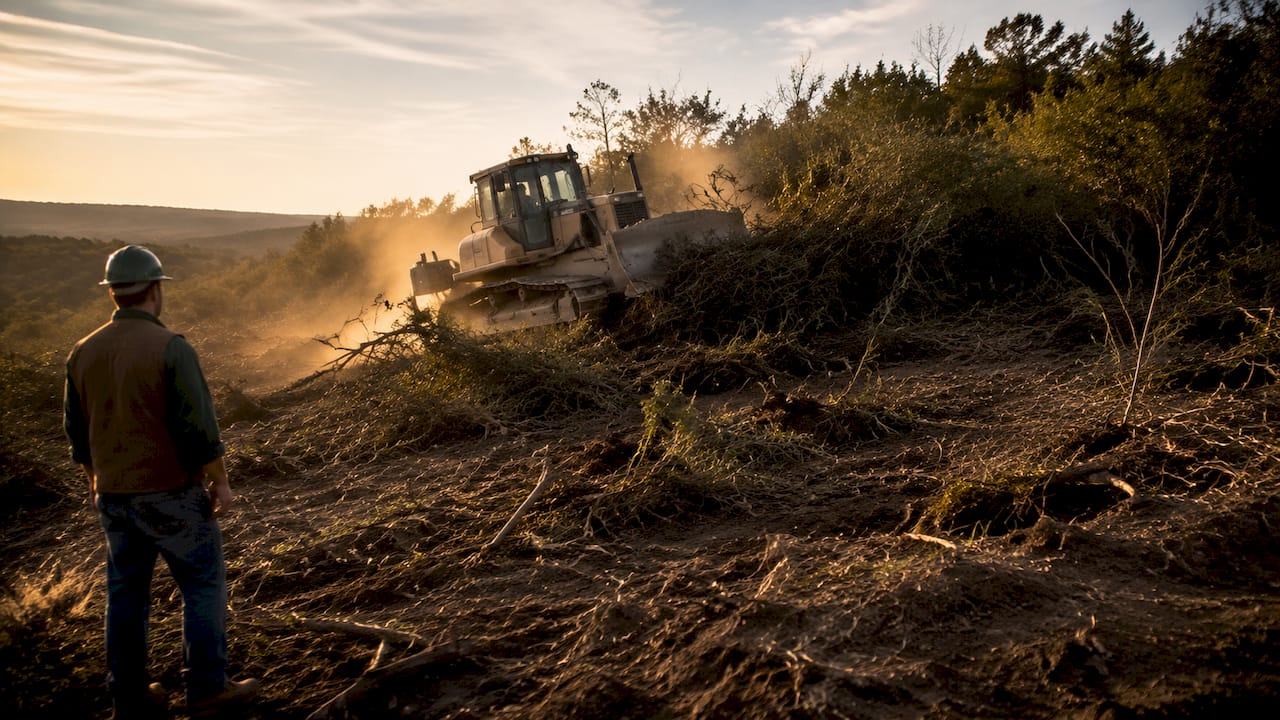
Bulldozing, also called pushover clearing, involves using a tracked dozer to push trees and brush to the ground, followed by grubbing to remove stumps and root systems. This method handles large areas with heavy vegetation or rocky terrain where mulching equipment cannot operate effectively. It is the standard approach for high-density timber sites and large commercial pads where speed takes priority over soil preservation.
Mechanical excavation uses excavators fitted with grapple saws, mulching heads, or bucket attachments to handle larger trees and dense timber with more precision than a dozer. This equipment is preferred near retained trees, underground utilities, or property boundaries where a bulldozer’s wide clearing path would cause unacceptable collateral damage. Selective precision clearing with grapple saws is critical near retained trees and underground services, balancing development needs with environmental stewardship.
The trade-off with both methods is soil disturbance. Bulldozing strips topsoil, increases erosion risk, and extends the time needed for site stabilization before construction can proceed. Compliance with erosion and sediment controls is not optional during these operations.
- Bulldozing is fastest for large, heavily vegetated areas
- Grubbing removes stumps and roots to construction-grade depth
- Excavators with grapple saws provide precision near utilities and retained trees
- Higher soil disturbance increases erosion risk and restoration time
- Sediment control measures must be in place before clearing begins
Pro Tip: Install perimeter silt fencing and sediment ponds before the dozer makes its first pass. Retrofitting erosion controls after soil is disturbed costs significantly more and may trigger regulatory notices.
4. Chemical and controlled burning techniques: risks and regulations
Chemical clearing uses herbicides to kill invasive species or suppress regrowth vegetation on sites where mechanical clearing alone is insufficient. It is effective for managing dense understory or post-clearing regrowth but requires careful application to prevent soil and water contamination. Chemical clearing and pile-burn methods carry higher risks and regulatory constraints than mechanical methods, and improper management can generate significant cleanup costs.
Controlled burning, also called prescribed fire, is a systematic technique for removing brush and undergrowth from large tracts. Prescribed fire requires detailed plans, weather condition evaluation, certified personnel, and go/no-go checklists before ignition. Texas A&M AgriLife Extension and the U.S. Army Corps of Engineers both publish structured programs for conducting safe prescribed burns on development-adjacent land.
Both methods are most effective when combined with mechanical clearing rather than used as standalone site preparation techniques. Regulatory constraints, air quality permits, and community safety concerns limit where and when these methods can be applied.
Before using chemical clearing or controlled burning on any development site, confirm local permit requirements, notify adjacent property owners, and verify that your contractor holds the certifications required by your state’s environmental agency. Non-compliance can halt a project and trigger fines that exceed the cost of the clearing work itself.
- Obtain all required air quality and burn permits before scheduling
- Confirm herbicide application complies with EPA and state label requirements
- Hire certified applicators for chemical work and certified burn managers for prescribed fire
- Notify adjacent landowners and local fire departments before any burn
- Document all applications, weather conditions, and inspection records
5. Planning and best practices for land clearing
Pre-clearing site assessments are the single most important investment you make before equipment arrives. Surveys, utility markings, wetland delineations, and protected-area boundary reviews must be completed and documented before any ground-disturbing activity begins. Unmarked utilities and misidentified wetland boundaries are the most common causes of costly project delays.
Arboricultural assessments define tree protection zones for any retained trees on the site. Integrating tree protection with erosion plans is critical for environmentally sensitive development, and most local jurisdictions require council-approved clearing scopes before work begins. Failing to establish these zones before clearing often results in root damage that kills retained trees months after the project is complete.
Stormwater compliance requires erosion prevention measures and sediment-containment devices installed prior to ground-disturbing activities, maintained consistently throughout clearing. Standard practice includes sediment ponds, perimeter barriers, and documented inspection schedules within a Stormwater Pollution Prevention Plan. These are not optional items. They are legal requirements on most permitted development sites.
Erosion control should prioritize prevention using mulching or seeding, with sediment control devices as a secondary backup. Prevention at the source reduces soil detachment more effectively than relying on sediment basins alone. Active system maintenance means weekly inspections, maintenance logs, and rapid repair of any breaches.
| Planning step | Why it matters |
|---|---|
| Utility and wetland survey | Prevents costly mid-project delays from unmarked services or protected areas |
| Tree protection zone mapping | Protects retained trees and satisfies council-approved clearing scopes |
| Stormwater Pollution Prevention Plan | Required on most permitted sites; defines sediment and erosion controls |
| Clearing sequence plan | Coordinates vegetation removal, grubbing, debris disposal, and rough grading |
| Erosion control installation | Must precede ground disturbance to meet regulatory and environmental standards |
Pro Tip: Sequence your clearing from the highest point of the site downward. This approach naturally directs stormwater runoff toward installed sediment controls rather than across freshly disturbed soil.
6. Comparing clearing methods: efficiency, cost, and environmental impact
Choosing the right method requires matching site conditions to method strengths. The table below summarizes the five core techniques across the factors that matter most to developers.
| Method | Speed | Erosion risk | Regulatory complexity | Best for |
|---|---|---|---|---|
| Forestry mulching | High | Low | Low | Moderate-density vegetation, stems under 35 cm DBH |
| Bulldozing | Very high | High | Moderate | Large areas, heavy vegetation, rocky terrain |
| Mechanical excavation | Moderate | Moderate | Moderate | Large timber, precision work near utilities |
| Chemical clearing | Low | Low | High | Invasive species control, regrowth suppression |
| Controlled burning | Moderate | Low | Very high | Large brush tracts, rural or agricultural sites |
For most residential and light commercial development sites in the Charleston area, forestry mulching delivers the best combination of speed, cost, and environmental performance. You can read a detailed breakdown of mulching versus traditional clearing to see how these factors apply to specific property types.
Contractor and equipment selection should be driven by your site’s stem size distribution, terrain, and proximity to sensitive areas. A contractor who quotes only one method regardless of site conditions is a red flag. The right crew will assess your vegetation density, soil type, and regulatory requirements before recommending an approach.
- Forestry mulching: best cost-to-performance ratio for moderate-density sites
- Bulldozing: fastest for large commercial pads but requires aggressive erosion management
- Mechanical excavation: most precise, preferred near utilities and retained trees
- Chemical clearing: effective for regrowth but requires certified applicators and permits
- Controlled burning: limited to rural sites with appropriate permits and certified personnel
Key takeaways
Effective land clearing for development requires matching the right method to site conditions, vegetation density, and regulatory requirements before any equipment enters the site.
| Point | Details |
|---|---|
| Method selection drives outcomes | Match forestry mulching, bulldozing, or excavation to stem size, terrain, and project scale. |
| Pre-clearing assessment is non-negotiable | Survey utilities, wetlands, and tree protection zones before ground disturbance begins. |
| Erosion control starts before clearing | Install sediment ponds and perimeter barriers prior to the first pass of equipment. |
| Regulatory complexity varies by method | Chemical clearing and controlled burning require permits, certified personnel, and documentation. |
| Sequence clearing for efficiency | Work from high to low elevation and coordinate grubbing, debris disposal, and grading in order. |
What I’ve learned from watching clearing projects go wrong
The projects that run over budget almost always share one trait: the clearing scope was defined before the site was fully understood. A developer commits to a method, a contractor quotes based on a site visit that missed a utility easement or a stand of protected trees, and the project stalls within the first week. The cost of a thorough pre-entry assessment is a fraction of the cost of a single day’s delay with a full crew on site.
Forestry mulching has become my preferred recommendation for most moderate-density sites in the Lowcountry. It handles the vegetation efficiently, leaves the soil in better condition, and avoids the erosion exposure that bulldozing creates on sandy coastal soils. The limitation is real, though. When a site has a significant mix of large-diameter timber, you need excavation capacity alongside the mulcher, not instead of it.
The other pattern I see repeatedly is erosion control treated as a paperwork exercise rather than an active system. Effective erosion and sediment control plans require continuous management including weekly inspections, maintenance logs, and rapid response repairs. A silt fence installed on day one and never checked again is not compliance. It is liability.
Local regulations in South Carolina, particularly around the Charleston Lowcountry, add layers of environmental review that developers from other markets often underestimate. Wetland buffers, tree preservation ordinances, and stormwater permit requirements are enforced actively. Choosing a contractor who knows these requirements and builds them into the clearing plan from the start is not a luxury. It is a project requirement.
— SEO
Professional land clearing services for your development project
Salvationlandmanagement provides forestry mulching, bulldozing, tree removal, and full site preparation services for residential and commercial development projects across Charleston, Mount Pleasant, James Island, Kiawah Island, and the surrounding Lowcountry.
The Salvationlandmanagement team manages environmental compliance, erosion control installation, and large-tract commercial clearing with equipment and crews matched to your site’s specific conditions. Whether you need comprehensive land clearing for a new home build or a large commercial pad, or specialized forestry mulching services for a moderate-density site, Salvationlandmanagement delivers on schedule and within budget. Contact the team today for a site assessment and project quote.
FAQ
What is the most cost-effective land clearing method?
Forestry mulching is the most cost-effective method for moderate-density sites because it converts vegetation to on-site mulch in a single pass, eliminating haul-away costs and reducing erosion risk. For heavy timber or large commercial pads, bulldozing is faster but requires additional erosion management costs.
How do I choose between forestry mulching and bulldozing?
The primary factor is stem size. Forestry mulching handles trees up to approximately 35 cm DBH efficiently, while bulldozing or mechanical excavation is required for larger timber or very dense vegetation. A site walk to assess stem size distribution before quoting is the standard practice.
What permits are required before clearing land for development?
Most development sites require a land disturbance permit, a Stormwater Pollution Prevention Plan, and wetland delineation review before clearing begins. Chemical clearing and controlled burning require additional air quality and application permits depending on your state and local jurisdiction.
How does land clearing affect soil erosion?
Clearing removes the vegetation cover that holds soil in place, making erosion control measures critical from day one. Prevention-first erosion control using mulching or seeding reduces soil detachment more effectively than relying solely on sediment basins installed after disturbance.
Can I clear land near retained trees without damaging them?
Yes, but it requires arboricultural assessment to define tree protection zones before clearing begins. Mechanical excavation with grapple saws provides the precision needed near retained trees, and debris removal practices should be planned to avoid compacting soil within root zones.
Recommended
- Land Clearing vs Forestry Mulching: Which Method is Right for Your Charleston Property? | Salvation Land Management
- Land Clearing Charleston, SC | Salvation Land Management
- Land Clearing & Tree Service Blog | Salvation Land Management
- Land Management Services James Island, SC | Salvation Land Management