
Storm tree debris disposal is defined as the process of sorting, transporting, and processing fallen branches, logs, and vegetative waste generated by severe weather events. After a major storm hits the Charleston Lowcountry or any region prone to high winds and heavy rain, property owners face an immediate and practical challenge: what do you do with all that debris? The right storm tree debris disposal options depend on the volume of material, your local municipal programs, and whether you want to reuse debris on your property. This article covers municipal pickup, free drop-off centers, on-property reuse, and professional tree debris removal services so you can make a clear, compliant decision.
1. What are the common municipal storm debris collection programs?
Municipal curbside pickup is the most widely used method for disposing of storm tree debris, and it comes with specific preparation rules that determine whether your pile gets collected or left behind. Sorting debris correctly before collection improves efficiency and eligibility for municipal collection programs. Mixing vegetative debris with construction materials is one of the most common mistakes homeowners make, and it causes collection crews to skip the pile entirely.
Most programs require you to separate debris into two distinct categories: vegetative waste (branches, leaves, logs) and construction or demolition materials (drywall, lumber, roofing). Cameron County, TX requires placing separated debris at roadway edges without blocking drainage and prohibits mixing it with household garbage. North Carolina’s Department of Public Safety requires cutting storm debris into 5 to 6 foot pieces and placing them curbside but out of travel lanes for NCDOT pickups. These rules exist to protect road access and allow mechanical collection equipment to work without manual sorting.
Key preparation rules for most municipal programs include:
- Separate vegetative from construction debris into two clearly distinct piles
- Cut branches and logs to the length specified by your county (commonly 5 to 6 feet)
- Place debris at the roadway edge without blocking drainage ditches, fire hydrants, or mailboxes
- Exclude hazardous materials such as paint, propane tanks, and appliances, which require separate disposal through county hazardous waste programs
- Do not mix household garbage with storm debris during special pickup windows
Pro Tip: Check your county’s emergency management website within 24 hours of a storm. Special pickup windows are often short, and placement deadlines can be missed if you wait.
Hazardous items are excluded from all standard storm debris pickups. NCDPS advises contacting your county emergency management office directly for guidance on paint, chemicals, and propane disposal. Ignoring this rule can result in fines or disqualification from the pickup program entirely.
2. How do free or low-cost local drop-off centers work?
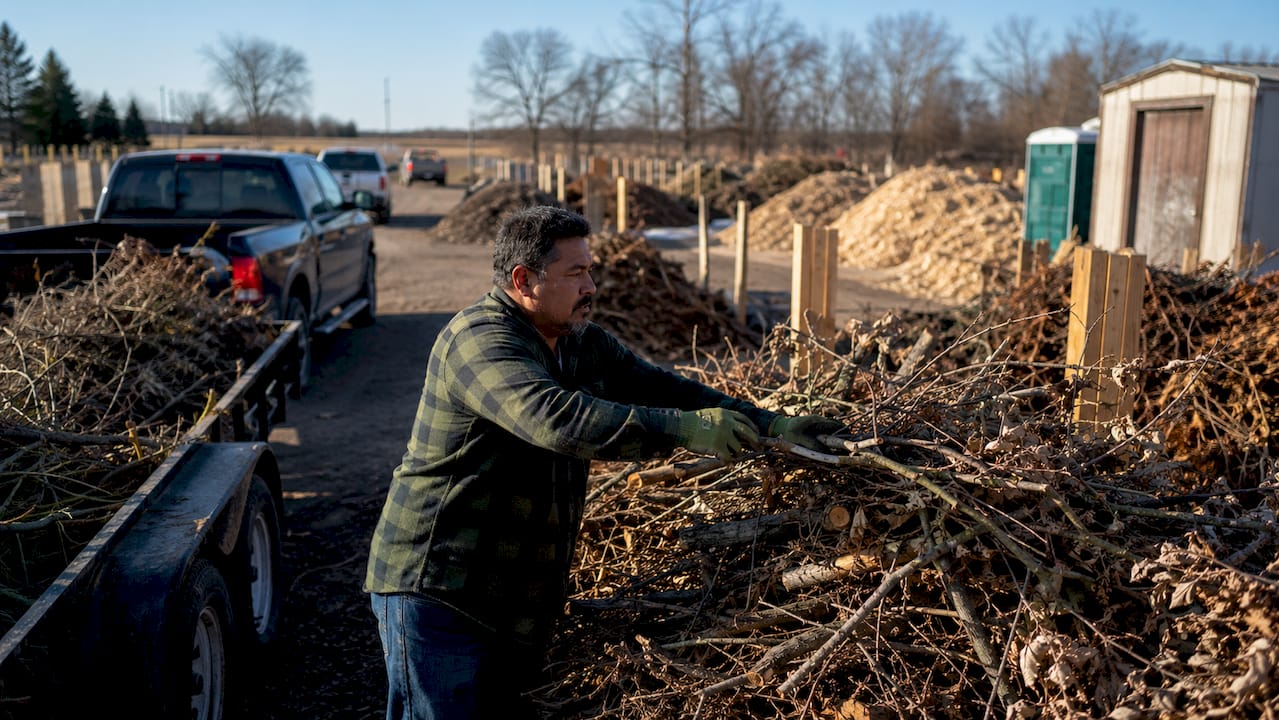
Free or discounted community drop-off sites give property owners a reliable alternative when curbside pickup is delayed, unavailable, or insufficient for large debris volumes. Boulder County’s community forestry sort yards in Nederland and Meeker Park run from May through November 2026, accepting branches and logs free of charge. Programs like this one demonstrate that municipalities increasingly treat storm debris as a resource rather than waste.
Here is how most drop-off programs are structured:
- Accepted materials: Branches, logs, and untreated wood. Stumps, soil, and construction debris are typically excluded.
- Size limits: Many sites cap individual pieces at 8 feet in length and require logs to be under a certain diameter.
- Operating hours: Most sites run on weekends or specific weekday windows. Boulder County’s sort yards operate seasonally, so timing matters.
- Proof of residency: Some programs, like Williamson County, TN, require a valid driver’s license and proof of residency to qualify for free disposal.
- Volume limits: Williamson County temporarily doubled its free storm debris disposal limit from 5 to 10 tons per resident through February 20, 2026. That increase reflects how much debris a single storm event can generate.
| Drop-off option | Best for | Cost | Key requirement |
|---|---|---|---|
| Community sort yards (e.g., Boulder County) | Branches and logs, seasonal | Free | Residency, size limits |
| County landfill with storm allowance (e.g., Williamson County, TN) | Large volumes post-storm | Free up to limit | Driver’s license, residency proof |
| Private transfer stations | Year-round, no volume cap | Fee-based | None beyond payment |
| Municipal drop-off events | Periodic storm recovery | Free | Scheduled dates only |
Drop-off centers work best when you have more debris than a single curbside pickup can handle, or when your municipality has not yet announced a special collection schedule. Call ahead to confirm hours and accepted materials before loading your truck.
3. What are on-property reuse options for storm tree debris?
On-property reuse is the most environmentally friendly tree disposal method available to homeowners, and it eliminates hauling costs entirely. Branches, leaves, and logs can be converted into mulch, compost, or firewood without leaving your property. The key is knowing which materials are safe to reuse and which require removal.
Practical reuse methods include:
- Composting: Add small branches, leaves, and green material to an existing compost heap. Chipping branches first accelerates decomposition. Avoid adding diseased wood, which can spread pathogens to your garden.
- Mulching garden beds: Chipped wood debris spread 2 to 4 inches deep around trees and shrubs retains soil moisture and suppresses weeds. This is one of the most direct storm debris cleanup tips that also improves your landscape.
- Woody debris features: Larger logs and branch piles can serve as habitat structures in naturalized garden areas. Some homeowners use them as informal borders or erosion barriers on slopes.
- Firewood: Hardwood logs from storm-felled trees can be split and seasoned for use in fireplaces or outdoor fire pits. Season wood for at least six months before burning to reduce smoke and improve combustion.
Pro Tip: Rent a wood chipper for a day if you have significant branch volume. Many equipment rental companies in the Charleston area offer chippers by the day, and the resulting mulch can cover an entire landscape bed.
One caution applies to all on-property reuse: do not use debris from trees treated with herbicides or those showing signs of fungal disease. Diseased wood introduced to compost or mulch beds can spread problems to healthy plants. When in doubt, remove it through a municipal or professional service.
4. How do specialized private services assist with storm debris removal?
Private tree debris removal services are the right choice when debris volume is large, trees have fallen on structures, or municipal programs cannot handle the scope of damage on your property. Professional crews bring equipment, liability coverage, and knowledge of local disposal regulations that most homeowners do not have access to on their own.
Private haulers must coordinate with local programs to verify acceptance conditions, including cut lengths and timing, to avoid disposal site refusals. This means a reputable professional service does not just haul debris away. It also handles compliance with municipal drop-off requirements on your behalf.
Situations where professional tree debris removal services make the most sense:
- Trees on structures: Fallen trees on roofs, fences, or vehicles require careful removal to avoid additional damage. This is not a DIY situation.
- Large-scale clearing: Properties with multiple downed trees or acres of debris benefit from professional equipment like forestry mulchers and grapple trucks.
- Permit requirements: Some municipalities require permits for debris removal from public easements or right-of-way areas. Professionals handle this paperwork.
- FEMA documentation: If you plan to file for disaster assistance, professional services can provide itemized receipts and documentation that support your claim.
Salvationlandmanagement provides land clearing in Charleston and surrounding areas, handling both residential and commercial storm debris with the equipment and experience to complete jobs safely and on schedule. Their crews understand the separation and sizing requirements of local municipal programs, which reduces the risk of disposal delays or rejected loads.
5. How to choose the best storm tree debris disposal option for your property
Choosing among the available storm tree debris disposal options comes down to four factors: debris volume, local program availability, cost, and your preference for reuse. No single method works for every situation, but a structured approach helps you decide quickly.
| Factor | Municipal pickup | Drop-off center | On-property reuse | Private service |
|---|---|---|---|---|
| Best debris volume | Small to medium | Medium to large | Small | Any size |
| Cost | Free (if eligible) | Free to low cost | Free | Fee-based |
| Speed | Depends on schedule | Same or next day | Immediate | Scheduled |
| Environmental benefit | Moderate | Moderate to high | Highest | Varies |
| Compliance support | Self-managed | Self-managed | Self-managed | Professionally managed |
A staged debris management workflow that includes sorting, sizing, and scheduling drop-offs or pickups minimizes delay and maximizes compliance benefits. Start by walking your property and estimating total debris volume. Then check your county’s emergency management page for active storm pickup schedules. If no program is active or the volume exceeds curbside limits, contact a drop-off center or a private service.
Safety is a non-negotiable factor in this decision. Do not attempt to move large logs or debris near power lines without professional help. Contact your utility provider before clearing any debris within 10 feet of electrical infrastructure.
Key takeaways
Effective storm tree debris disposal requires sorting debris correctly, matching your volume to the right program, and following local placement rules to avoid delays or rejection.
| Point | Details |
|---|---|
| Sort before anything else | Separate vegetative from construction debris immediately to qualify for municipal pickup. |
| Know your local programs | Check county emergency management pages for active pickup windows and drop-off site hours. |
| Reuse debris when possible | Mulching and composting storm debris on-site is the most cost-effective and environmentally sound option for smaller volumes. |
| Call professionals for complex jobs | Trees on structures, large acreage, or FEMA documentation needs require licensed, insured crews. |
| Compliance protects your eligibility | Mixing prohibited items or missing placement rules can disqualify your debris from free collection programs. |
What I’ve learned coordinating storm debris cleanup in the Lowcountry
After working through multiple storm seasons in the Charleston area, the single biggest mistake I see property owners make is waiting. They wait for a neighbor to go first, wait for the county to announce a program, or wait until the debris pile becomes a safety hazard. By then, the pickup window has often closed or the drop-off site has reached capacity.
The second mistake is underestimating how much sorting matters. Improper mixing of vegetative and construction debris commonly leads to operational delays and rejection of entire debris piles by collection crews. I have seen homeowners lose their only pickup opportunity because a single piece of drywall ended up in the branch pile.
My honest recommendation: treat the first 48 hours after a storm as your planning window. Walk the property, photograph the damage, separate the debris, and contact your county. If the volume is beyond what curbside pickup can handle, call a professional service before the backlog builds. Community forestry programs like Boulder County’s sort yards are genuinely useful for sustainability-minded property owners, but they require you to know the schedule in advance. Staying current on local policies is not optional. It is the difference between a clean property and a months-long cleanup.
— SEO
How Salvationlandmanagement can help after a storm
When storm debris exceeds what municipal programs can handle, Salvationlandmanagement is ready to step in with the equipment and expertise Charleston-area property owners need.
Salvationlandmanagement offers professional tree removal and forestry mulching services designed specifically for post-storm recovery. Their crews handle debris separation, sizing, and transport in compliance with local municipal requirements, so you do not have to manage the logistics alone. Whether you own a single residential lot or a large commercial property, Salvationlandmanagement has the capacity and experience to restore your land safely and efficiently. Contact them directly to schedule an assessment and get a clear, itemized quote for your cleanup project.
FAQ
What are the main storm tree debris disposal options?
The main options are municipal curbside pickup, free or low-cost community drop-off centers, on-property reuse through composting or mulching, and private tree debris removal services. The best choice depends on debris volume, local program availability, and cost.
How do I prepare debris for municipal pickup?
Cut branches to the length your county specifies (commonly 5 to 6 feet), separate vegetative debris from construction materials into two distinct piles, and place them at the roadway edge without blocking drainage or traffic lanes.
Are drop-off centers free for storm debris?
Many are free for eligible residents during storm recovery periods. Williamson County, TN doubled its free disposal limit to 10 tons per resident after a 2026 storm event, requiring proof of residency and a valid driver’s license.
Can I reuse storm tree debris on my property?
Yes. Branches and leaves can be composted, chipped wood can be used as mulch, hardwood logs can be seasoned for firewood, and larger woody debris can serve as landscape features. Avoid reusing diseased or chemically treated wood.
When should I hire a professional tree debris removal service?
Hire a professional when trees have fallen on structures, debris volume exceeds municipal program limits, permits are required, or you need itemized documentation for a FEMA disaster assistance claim.